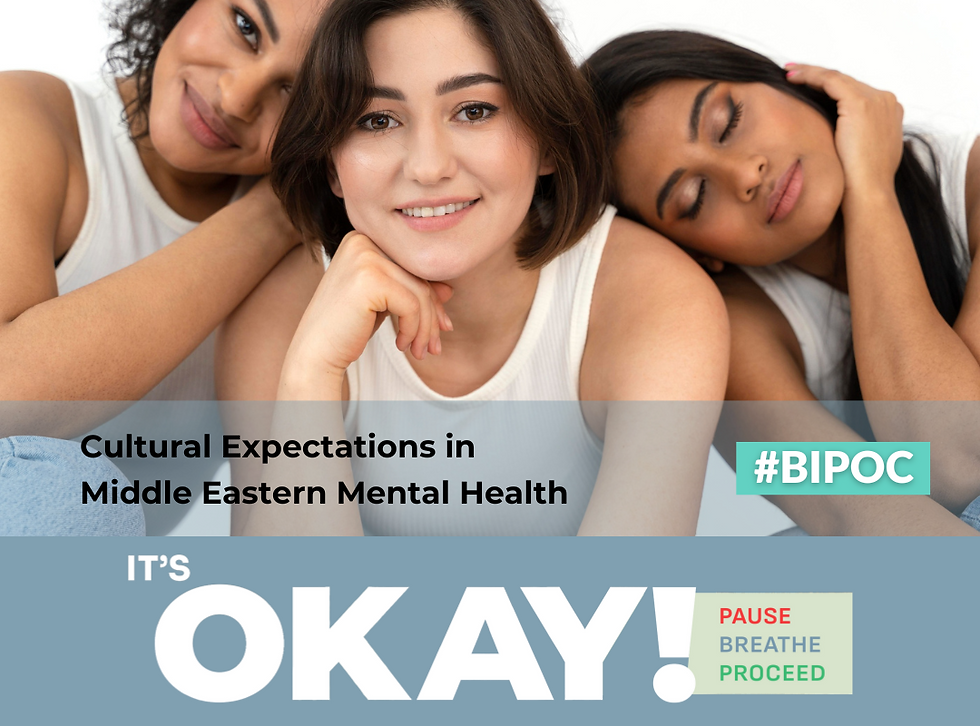
Celebrating BIPOC Mental Health Awareness Month with Culture, Community and Connection

The past ten years have witnessed a surge in discussions about and advocacy for mental health awareness. Celebrities now speak openly about struggling with depression, therapy services such as Better Help have increased in popularity, and over 48 million Instagram posts share the hashtag #mentalhealth. However, this dialogue often isn’t placed in the context of the distinct mental health struggles encountered by members of the BIPOC (Black, Indigenous, People of Color) community. With July marking the 15th annual BIPOC Mental Health Awareness Month, there is no better time to start the conversation around minority mental health and learn more about how we can show our support.
One way to do that is to join us for It’s OKAY! Pause, Breathe, Proceed – BIPOC, streaming on Monday, July 31st at 4 pm PT/ 6 pm CT/ 7 pm ET. Hear from experts in the mental wellness space addressing the issues encountered in BIPOC communities. ASL interpretation will be provided. You can register for this free event here.
What is BIPOC Mental Health Awareness Month?
Founded by Congress in 2008, BIPOC Mental Health Awareness Month was originally designated as Bebe Moore Campbell Minority Mental Health Awareness Month in honor of Bebe Moore Campbell, mental health advocate and founder of the National Alliance on Mental Illness (NAMI) Los Angeles. During her lifetime, Campbell went to great lengths to illuminate the mental health needs of those in underrepresented communities. In 2020, the name shifted to using the acronym BIPOC to include all Black, Indigenous, People of Color while still recognizing each group’s distinct identity.
The main goals of BIPOC Mental Health Awareness Month are to:
Raise public awareness of mental health issues faced by the BIPOC community
Improve BIPOC access to mental health treatment and services nationwide
Why is it important to recognize the mental health struggles of the BIPOC community?
While people of all races and ethnicities can experience mental health concerns and illnesses, it is important to recognize that members of minority groups face unique challenges when it comes to mental health. Systemic racism embedded within American social, cultural, and political structures, along with racial trauma, serve to amplify the risk of experiencing mental health disorders. Despite being more vulnerable to mental health issues, members of the BIPOC community are less likely to receive treatment due to disparities in access to mental health treatment and support, underrepresentation in mental health care providers, discriminatory medical practices, and cultural stigma that prevent some from seeking help.
Here are a few facts highlighting the disproportionate mental health outcomes of the BIPOC community:
Data from the Pew Research center shows that roughly 76% of Black Americans report facing discrimination. Self-reported discrimination is positively associated with depression and anxiety symptoms and psychological distress.
According to the Department for Health and Human Services, Asian Americans are 60% less likely to have received mental health treatment compared to non-Hispanic whites
A report from the NYS Office of Mental Health states that only 1 in 3 African Americans who need mental health care receive it.
A 2018 survey conducted by SAMHSA found that 56.8% of Hispanic young adults 18-25 and 39.6% of adults 26-49 with serious mental illness did not receive treatment.
Mental Health America reports that Native/Indigenous people in America report experiencing serious psychological distress 2.5 times more than the general population over a month’s time.
How can we show support?
You have the power to make a difference! Together we can change the stigma surrounding minority mental illness and improve access to care for the millions of Americans affected. Here are just a few ways to show your support and become an ally for the cause:
Raise awareness of BIPOC Mental Health Month by posting on social media and encouraging friends and family members to do the same
Volunteer your time or donate to an agency or nonprofit organization dedicated to helping those in the BIPOC community with mental health concerns
Download Mental Health America’s BIPOC Mental Health Awareness Month Toolkit to educate yourself on the mental health challenges faced by members of the BIPOC community
Check out the website of the National Alliance on Mental Illness (NAMI) to learn more about how you can bring the cause to policymakers and advocate for policies to improve BIPOC mental health outcome
Want to learn more? Here is a free resource guide from Mental Health America with educational materials, organizations to support, and mental health resources for members of BIPOC communities.
Her Nexx Chapter invites you to join our Community where women from around the world are connecting, exploring, and transforming lives.
The Future of Connection for Women

My name is Reese Fortier, and I am a student studying psychology and neuroscience at Wake Forest University. My passion for wellness comes from years spent trying to figure out what healthy meant amongst the excess of conflicting information coming at us from the media, as well as the messages we as women receive about how our bodies should look and function. During this journey, I worked with my own coach, and my experience with her sparked my desire to help women in a similar way. My background in psychology and neuroscience, as well as nutrition and physiology courses, has given me a holistic lens through which to view health and fitness. Ultimately, my goal is to guide women to pursue their own definition of health.